JANET BARBARA JOHNSON
March 5th, 1940 - August 21st, 1999
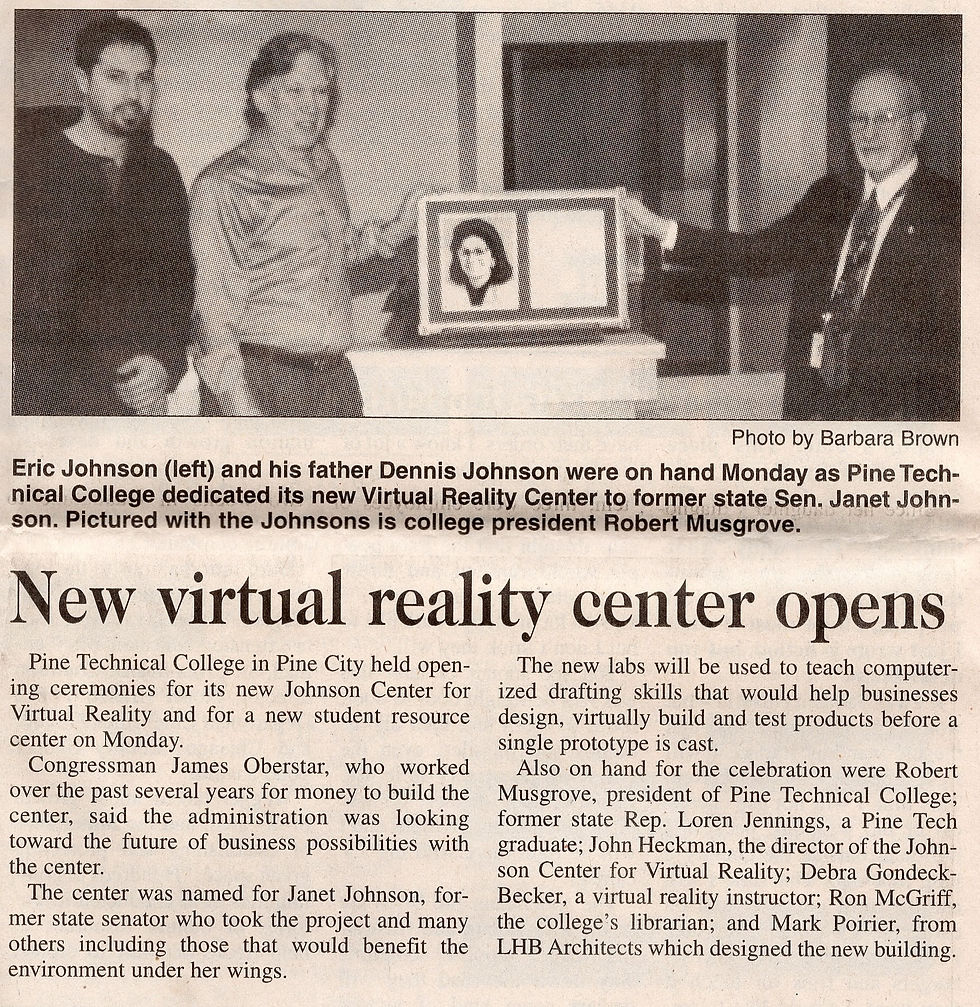
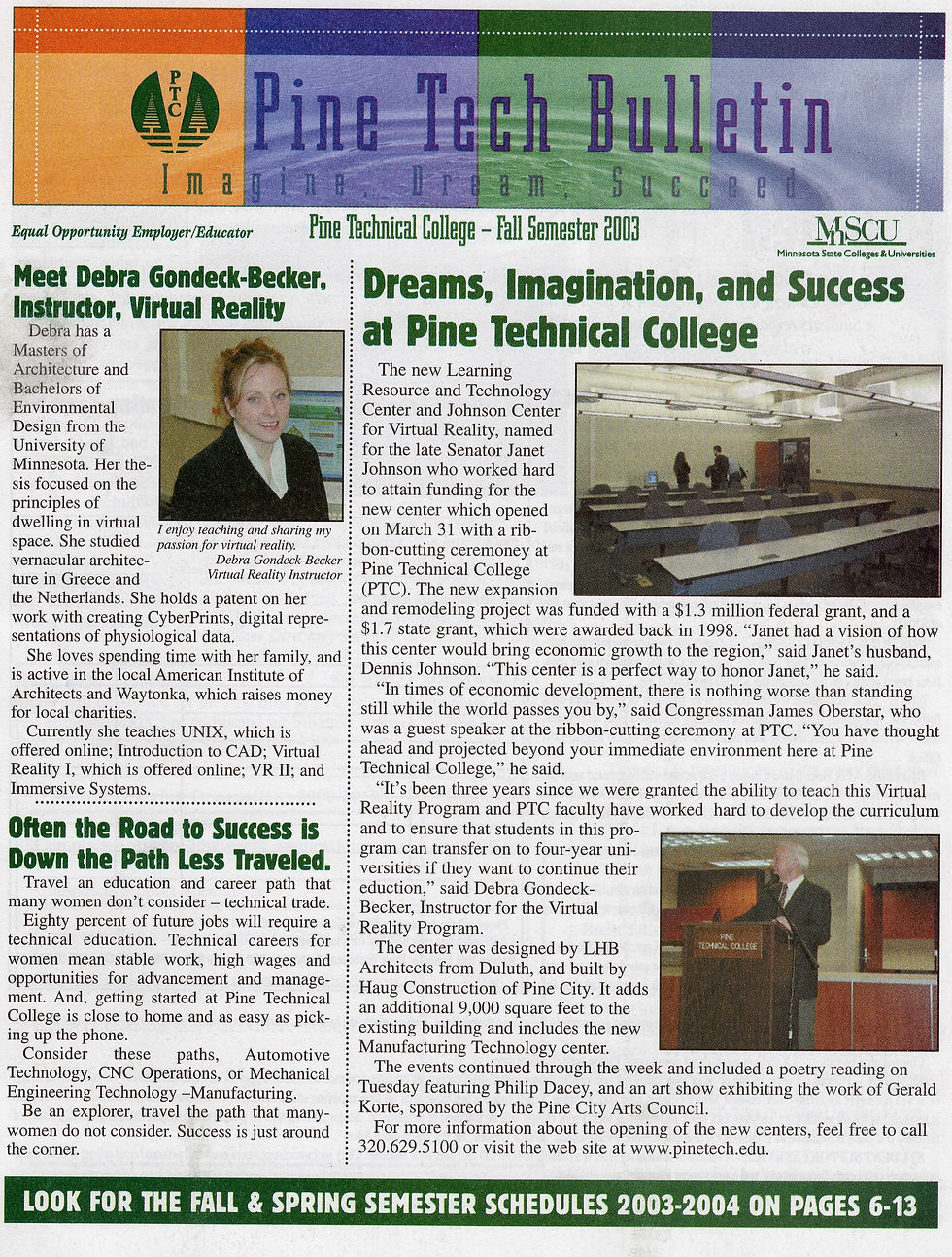
The Johnson Center for Virtual Reality began with President Robert Musgroves vision of Pine Technical College as the foundation of high technology development in the East Central Minnesota region. This virtual concept is becoming a reality now, with over $2,000,000 in projects in progress, including a 3,000 square foot building addition to house the Center. The new addition will include development, laboratory, and display space for high technology initiatives.
The mission of the Johnson Center for Virtual Reality is to enable and support the use of computer simulation to improve education and training, to promote economic development, and to enhance decision-making processes. The Center works with state and local agencies, education systems, other organizations, and business and industry to build simulations and promote economic development.
If you want to look at how VR might help you or your organization, please contact:
John Heckman, Director
Johnson Virtual Reality Center
Pine Technical College
1000 Fourth Street
Pine City MN 55063
(320) 629-5143
fax (320) 629-5101
________________________________________
What is Virtual Reality?
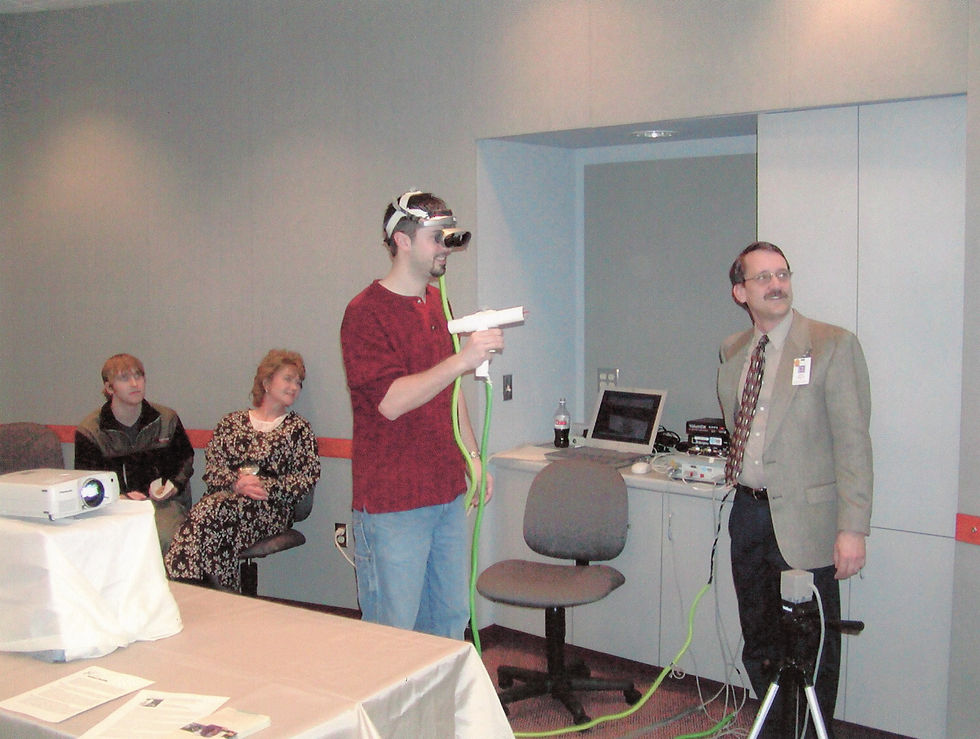
Virtual reality is the use of computer software and hardware to simulate real-life situations for training, entertainment, or decision making. A virtual reality application is realistic and interactive, allowing the user to affect and respond to the virtual environment of the simulation. In a virtual reality training application, the learner may interact with the things he or she is studying in a three-dimensional and lifelike manner. In immersive training, the learner may be wearing head-mounted display goggles and special gloves to perform realistic operations very much like the actual tasks.
Current Projects
New Building
Lathe Simulation
Automotive Service Simulation
Credit program: Virtual Reality Applications Technology AAS Degree
Why use Virtual Reality simulations in technical training?
Computer-based virtual reality training is ideal when real reality training would be too expensive, too dangerous, inconvenient, or unavailable. Our first simulation project, for example, will create a training simulation of setting up a CNC lathe. The real machine is worth about a half-million dollars, and the simulation will let people learn off-line while the real machine stays in production.
Where did the Johnson in the Johnson Center for Virtual Reality come from?
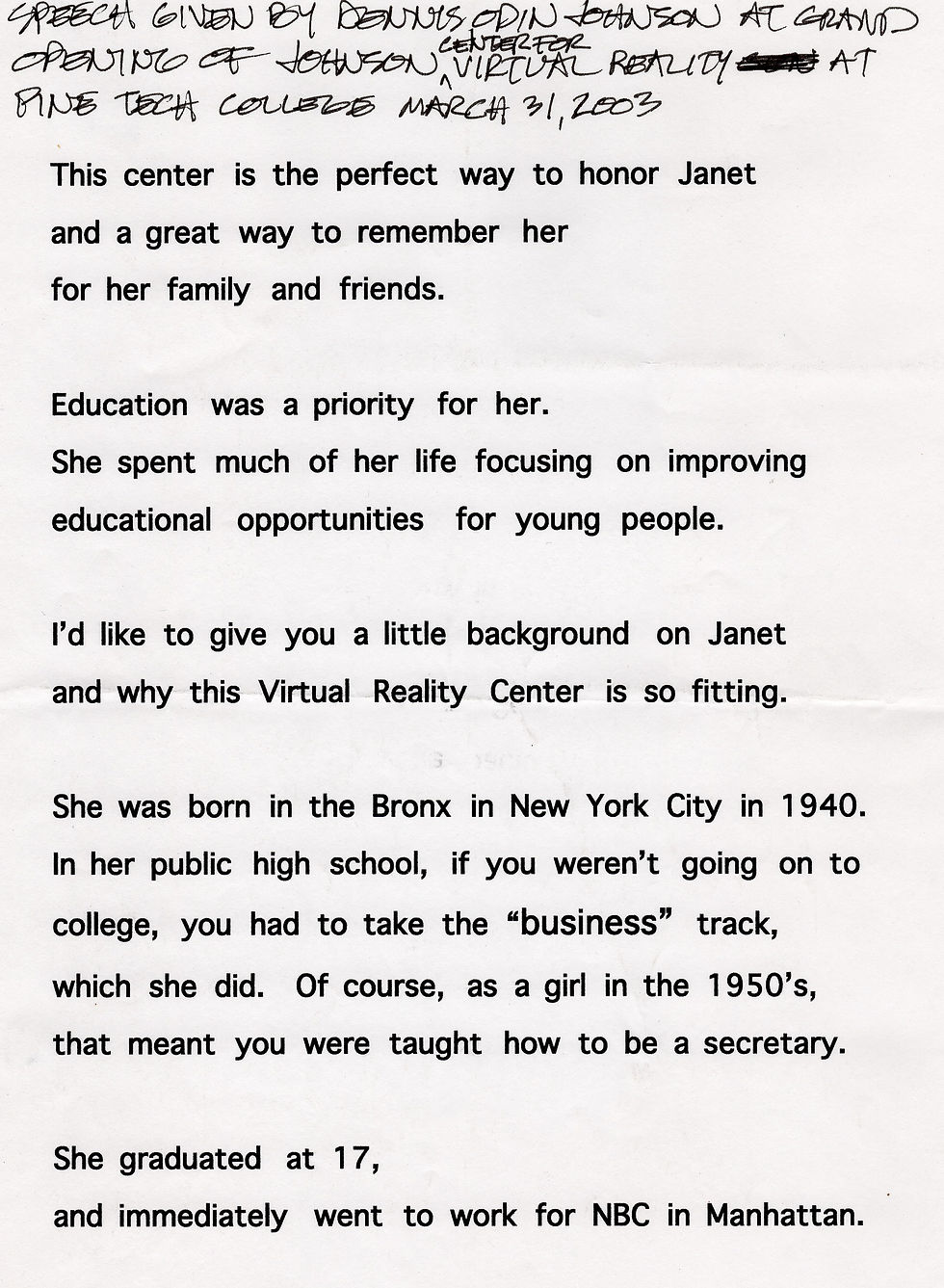
The center name honors the late Minnesota State Senator, Janet Johnson. Senator Johnson was a strong advocate for Pine Technical College and public education during her whole distinguished political career. Her untimely and sudden death in August of 1999 was a deep loss to the state and region. We chose this way to commemorate her.
Partners
Minnesota Job Skills Partnership
MnSCU Emerging Curriculum Program
Atscott Manufacturing Company, Inc. in Pine City, Minnesota
Glenn Metalcraft, Inc. in Princeton, Minnesota
Raven Machine & Tool, Inc. in Mora, Minnesota
Motek Engineering and Manufacturing, Inc. in Cambridge, Minnesota
Schlagel, Inc. in Cambridge Minnesota
________________________________________
Building Project
The Economic Development Administration of the U. S. Department of Commerce has awarded an $830,000 grant to construct a 3,000 square foot addition to house the Johnson Center for Virtual Reality and new virtual reality labs and programs. This project is in the planning stages and construction is expected to begin in the summer of 2000.
Lathe Simulation Project
The Minnesota Job Skills Partnership (MJSP), Pine Technical College, and five regional manufacturers are working together in a $1.2 million project to develop virtual reality training for machine tool operators. The virtual reality simulations will be used to train workers at Atscott manufacturing Company, Inc., in Pine City, Glenn Metalcraft, Inc. in Princeton, Raven Machine & Tool, Inc. in Mora, and Motek Engineering and Manufacturing, Inc. and Schlagel, Inc. of Cambridge. This two year project will train 211 production employees while reducing costs and increasing efficiency for the employers. This application of VR training makes sense because of the tremendous cost of training people on actual machines.
Automotive Service Simulation Project
One objective of the $200,000 grant from the Minnesota State Colleges and Universities (MnSCU) is to produce a training simulation for an automotive service procedure such as disk brake service or steering alignment. This simulation will allow MnSCU automotive students system-wide to learn and practice on a simulated car before they work on real cars. This simulation will teach the critical parts and sequences of the processes and prepare students for the actual work. Minnesota State Colleges and Universities (MnSCU) and Pine Technical College are partners in this $441,000 project to produce VR training simulations, to jump-start our new Virtual Reality Application Technician program, and to help bring this technology to other schools.
Virtual Reality Applications Technology AAS Degree
Beginning with Fall of 2000, Pine Technical College will offer a new Associate of Applied Science degree in Virtual Reality Applications Technology. With strong emphasis on computer programming, graphics designs, and virtual reality, graduates will be prepared for work in a wide variety of high-tech and high-pay jobs.
Posted 12/15/99
Virtual Reality arrives
By Jon Tatting
Employers seeking basic job skills from graduating students may feel more at ease after seeing what Pine Technical College is developing.
And Dr. Robert Musgrove is watching an idea become a reality through an alternative sense of sight and feel or Virtual Reality.
As president of Pine Tech, based in Pine City, Musgrove looks to implement a Virtual Reality Center which will train students via computers to simulate physical environments within applications including industrial and technological tasks.
By strapping on wire-connected headgear and gloves, a person can enter Virtual Reality upon looking through the equipped visor. Through an automotive program, for example, hand movements can manipulate a virtual hand to pick up different car parts or tools.
Pine Tech will be the first educational institution statewide to implement a VR center, which will be named the Janet Johnson Center for Virtual Reality. Musgrove unveiled the name in honor of the late senators vision of technology and education.
The building that will house the VR center is expected to be built next summer; student enrollment is anticipated for fall of 2000.
Last week, Pine Tech was awarded a $400,000 grant from the Minnesota Job Skills Partnership to train 211 employees at five local companies in virtual reality applications.
The college also received a second grant worth almost $200,000 to train and certify 700 retail and management employees working in the five-county region.
Both grants were signed and recognized by the college and MJSP during a ceremony at Pine Tech on Thursday, Dec. 9.
The MJSP program is responsible for offering technical, financial and job training assistance to Minnesota businesses, communities, educational institutions and workers across the state.
MJSP Director Roger Hughes spoke at the ceremony, noting that a consortium of area businesses, employees and customers will benefit from the improved training efforts.
Regarding Virtual Reality applications, key benefactors will be on-campus students as well as those taking courses from remote sites. Overall, Musgrove emphasizes distance learning at Pine Tech.
We were searching for ways to improve distance learning for those students living miles away, said Musgrove, who first became interested in virtual programming five years ago.
Virtual Reality programs will allow lab opportunities as well as class lectures via current interactive television. In essence, students with compatible computer systems could download virtual programs from their own homes.
We could teach the whole program at a distance, said Musgrove.
Last spring, three Pine Tech instructors received Virtual Reality training before receiving Eon Reality VR development software worth up to $5,000. With the software, they will learn various programs to teach people set-up procedures for manufacturers.
Other institutions use Virtual Reality for home tours, entertainment, therapy and surgery practice. Though the real thing will most likely never be replaced in training environments, virtual programs can help refine skills, Musgrove said.
There is so much potential in this for the college, state and higher education, he added.